 Hynek Oubrecht
  2026-08-05 14:10:21
  3 min reading
For many years, classic exit-intent was one of the main tools for capturing users just before they left a website. However, today's user behavior has changed significantly – and with it, the possibilities for recognizing this critical moment. This is where Browse-Burst comes in.
Browse-Burst is a technology developed by Mailnatives and is available exclusively on the Mailocator platform. You won't find it in any other tool or as a standalone solution.
Following a pilot run at the end of 2025, Browse-Burst has been available in all versions of Mailocator since January 2026.
Exit-intent: a powerful concept with clear limitations
Exit-intent works on a simple principle: it tries to recognize the moment when a user leaves a page and displays a campaign at that moment. It typically relies on signals such as the cursor moving toward the top edge of the window or loss of focus on the page.
Limits of classic exit intent
Although exit intent is conceptually powerful, it has several significant limitations:
- it only responds when the user has practically decided to leave,
- it works with a very limited number of signals,
- on touch devices (mobile phones, tablets), its functionality is significantly limited or non-existent,
- Signals are often not relevant enough to the user's actual intent.
- To achieve results, it was often necessary to use more aggressive campaigns (significant discounts), which inevitably led to an increase in the price of the lead and a decrease in the long-term value of the customer.
As a result, the campaign is displayed late – or not at all – and often goes unnoticed by the user.
Browse-Burst: smarter work with user behavior
Browse-Burst was created in response to the limitations of classic exit intent and changes in how users actually behave on the web. This is not a minor adjustment to existing technology, but a new approach based on data and long-term observation of real visits.
At Mailnatives, we analyzed more than 11 million interactions captured by Mailocator from users with significantly high bounce rates over a two-year research period.
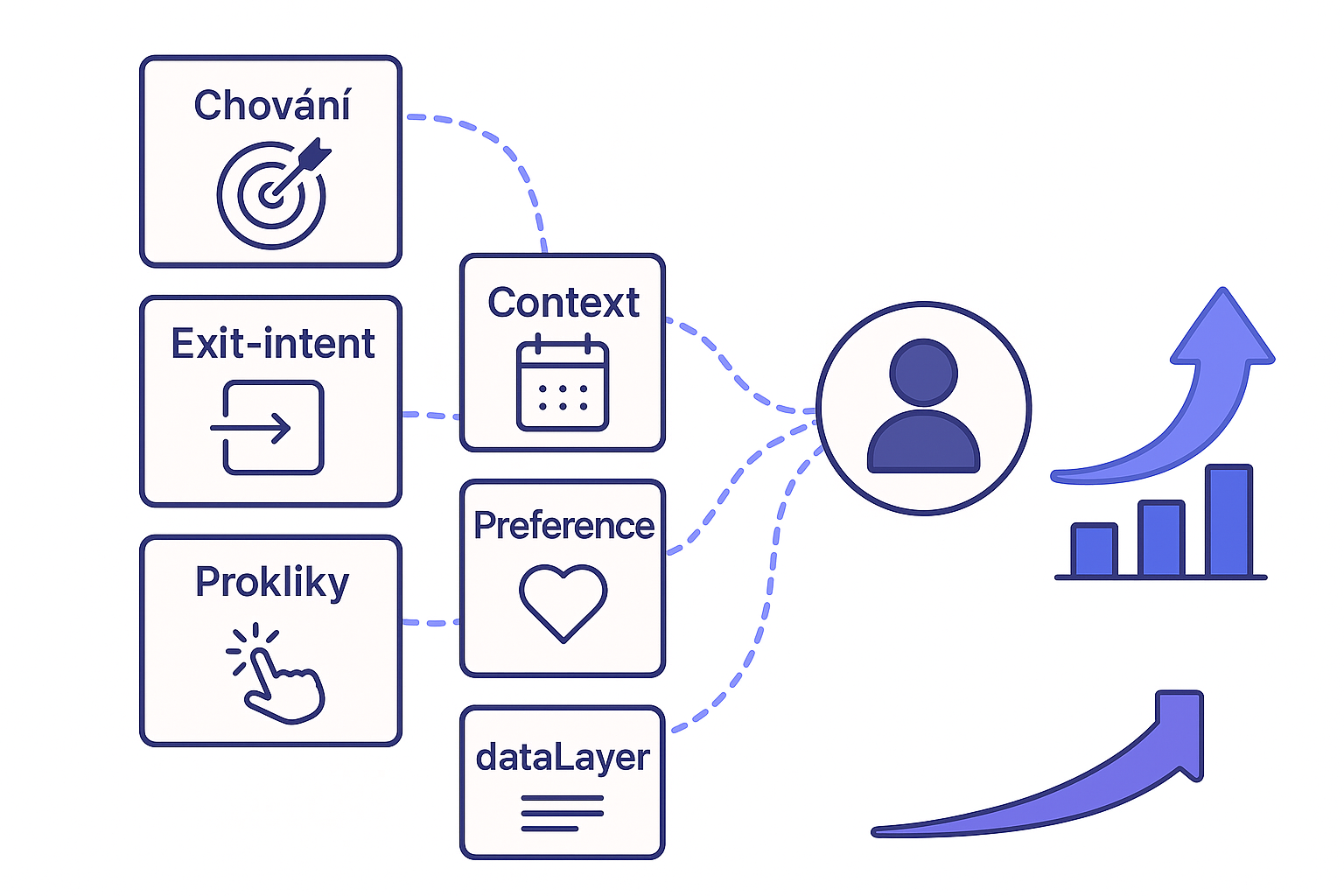
Based on this research and gradual testing, a set of four configurable events was created that can recognize critical moments during a visit much more accurately.
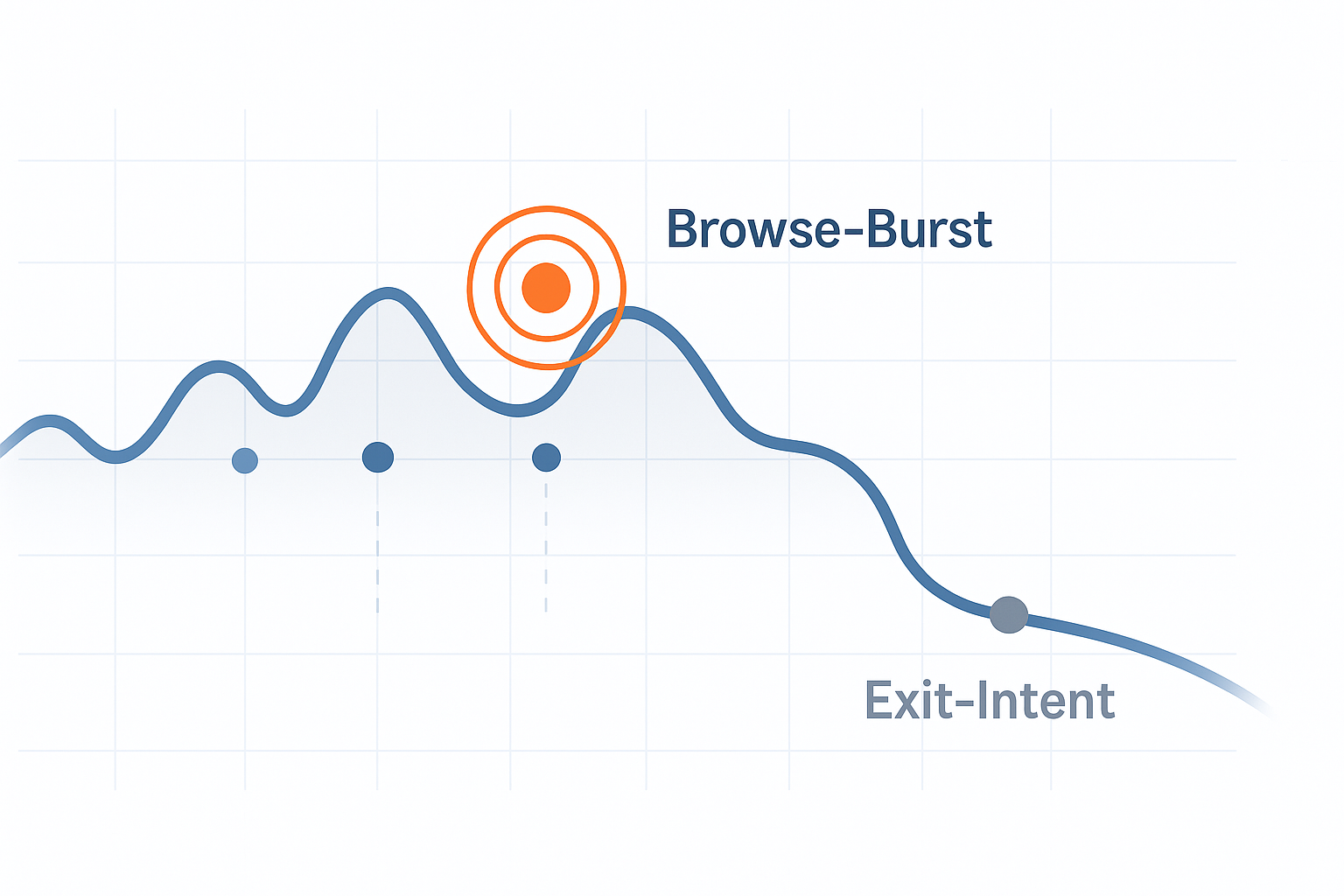
Test results showed that Browse-Burst achieves 67.12% better and more accurate detection than classic exit-intent. In practice, this means that campaigns are displayed when the user is still active, which can lead to up to a 50% increase in conversions compared to the traditional approach.
The main advantage of Browse-Burst is its ability to find the moment when the user is still on the page, but their behavior already indicates a high probability of leaving. It is at this stage that communication still makes sense – unlike exit intent, which only reacts when the decision to leave is practically final.
Does it make sense to combine exit-intent with Browse-Burst?
Yes – and it makes a lot of sense. If you already use exit-intent, there is no need to turn it off. The ideal scenario is a combination of both approaches.
Mailocator now supports multiple triggers in a single campaign, so you can:
capture users with Browse-Burst before the classic exit intent
leave exit intent as the last point of contact
Just add Browse-Burst (or just part of it) to your existing campaign and fine-tune the frequency and priorities.
To use this feature, you must have Mailocator snippet version 6 or higher installed.
Browse-Burst is not a replacement for exit intent, but its evolution.
Instead of reacting to departure, it works with behavior, context, and probability. This allows you to reach users at the right moment – earlier, more gently, and with significantly better results.